Your first week on the air
Turn your new license into a few small, practical steps. Go at your own pace.
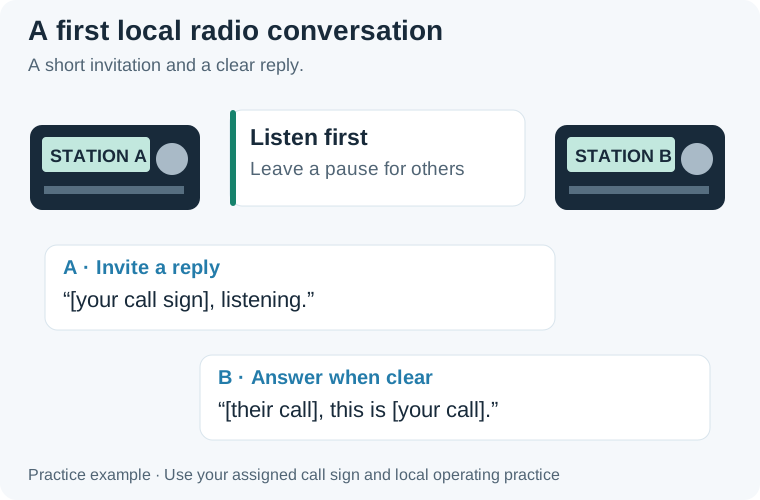
Replace the placeholders with assigned call signs. This is a simple local FM example; an HF CQ exchange starts differently. Listen to the activity and leave space for the other station to answer.
Open larger imageConfirm your starting point
For your first US license, check that the FCC has granted it and assigned your call sign before operating under your own license. Keep the call sign handy. Check the allowed frequencies and modes for your license class; a radio’s ability to tune somewhere does not give you permission to transmit there.
Choose one goal
Start with something specific: hear a local conversation, join a club net, or make a short contact. Write down one question you want help with. You can learn the controls on borrowed equipment or with a mentor before deciding what to buy.
Listen and make notes
Find a local club or repeater listing and confirm the information with someone who uses it. Listen for call signs, pauses, and how people join in. Note the frequency, settings, and a time when the channel is active. A quiet frequency does not necessarily mean your radio is broken.
Arrange a first conversation
Ask an experienced operator to listen for you at an agreed time. Check the antenna and radio settings together. When the channel is clear, give your call sign and say you are looking for a signal report. A planned contact removes some of the guesswork.
Keep a small learning log
Write down what worked, what was confusing, and what to try next. Your first week does not need a particular number of contacts. A good next step might simply be learning to recall a saved channel without help.
Try it together
Listen together and see who can recognize a call sign first. Practice introductions with the transmitter off before trying an actual contact.
Inspired by beginner learning material shared by Patrick Brown, N7FHB. Written and updated for Signal School.
Keep learning
Reviewed November 20, 2026.