Program your first repeater
Understand the frequency, offset, and access tone before saving a channel.
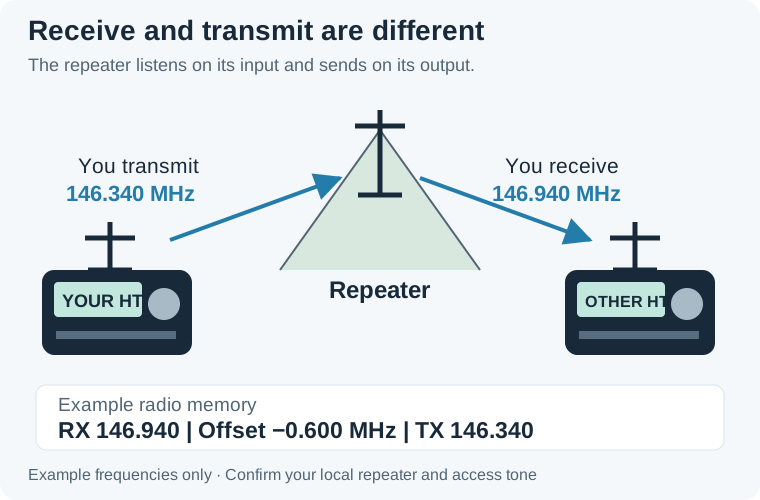
Your radio receives the repeater’s output and transmits on its input. These numbers are a teaching example, not a local repeater recommendation. Use the actual listing for the offset and access tone.
Open larger imageStart with a current listing
Find a repeater you are allowed to use and confirm its details with the owner or local club. For analog FM, record its output frequency, input frequency or offset, and access tone. Digital repeaters need compatible equipment and additional settings. Menu names differ between radios, so keep your manual nearby.
Work out where your radio transmits
Your radio listens on the repeater’s output and transmits on its input. For a practice example only, an output of 146.940 MHz with a minus 0.600 MHz offset means an input of 146.340 MHz. These example numbers do not establish a usable local repeater.
Set the direction and amount separately
Choose minus or plus and then the offset amount. Common US offsets include 0.600 MHz on 2 meters and 5.000 MHz on 70 centimeters, but the direction and amount must match the actual listing. Do not assume every UHF repeater uses a positive offset.
Check the tone setting
Enable the listed transmit access tone when required. CTCSS may be called tone or PL in your radio. Receive tone squelch is a separate setting: a mismatch can hide a repeater you would otherwise hear. Follow the listing and manual rather than copying one tone into every field.
Listen, identify, and save
Listen first. When clear, press push to talk, pause briefly, and identify with your own call sign before asking for a radio check. A response is useful evidence; silence alone does not prove failure. Recheck the listing, antenna, range, mode, and tone with a mentor. Save a clearly named memory channel once the settings are confirmed.
Try it together
On paper, subtract 0.600 from 146.940. One number is where the repeater talks; the other is where it listens. Practice changing settings with transmission disabled.
Inspired by beginner learning material shared by Patrick Brown, N7FHB. Written and updated for Signal School.
Keep learning
Reviewed November 20, 2026.