Choose your first radio and antenna
Match a simple setup to the contacts you want to make.
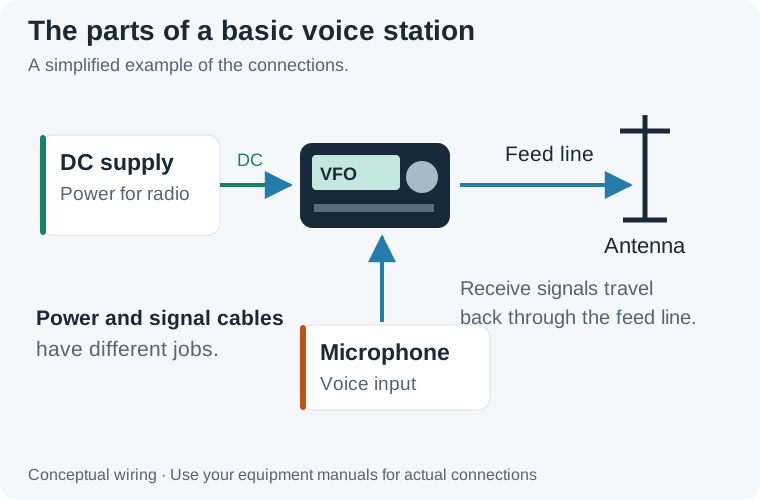
Power, microphone audio, and radio frequency signals have different paths. Received signals travel from the antenna back through the feed line to the radio. This is a concept diagram, not installation wiring.
Open larger image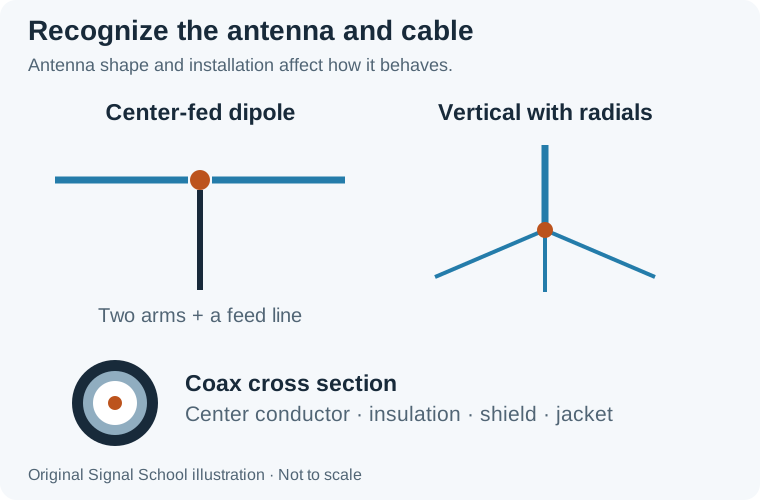
The orange dots mark feed points. The cable cross section shows how its center conductor is kept separate from its shield. Real dimensions and installation details depend on the band and design.
Open larger imageStart with the people you want to reach
Ask local operators which bands and modes are actually active near you. Local FM conversations, digital voice repeaters, and HF contacts can require different equipment. A radio with more features is not automatically a better first choice. Try a club demonstration before shopping.
Compare handheld, mobile, and home setups
A handheld puts the battery, controls, and antenna in a small package. A mobile radio usually needs an external antenna and suitable DC power; it can also be used at home with the right supply. An HF station needs equipment and an antenna suited to the bands and modes you plan to use.
Plan the antenna at the same time
Consider the operating band, available space, antenna placement, feed line, and connectors. For a vehicle, a magnetic mount can be convenient, while a permanent mount needs a suitable installation. Performance depends on the complete antenna system, not just whether a hole was drilled. Follow the manufacturer’s mounting instructions.
Include the whole cost
List the radio, antenna, mount or support, feed line, power supply or battery, and any programming cable. For used equipment, ask for a working demonstration, the manual, and a clear description of faults. A mentor can help check compatibility before you buy.
Get help with installation
Keep antennas and supports well clear of power lines, including anywhere they could fall. Ask an experienced installer about secure mounting, cable routing, grounding, lightning protection, and RF exposure. Start with a safe, understood setup and improve it as you learn.
Try it together
Make a picture of your planned station and label the radio, power source, cable, and antenna. Explain the job of each part before buying anything.
Inspired by beginner learning material shared by Patrick Brown, N7FHB. Written and updated for Signal School.
Keep learning
Reviewed November 20, 2026.