Make your first HF voice contact
Listen for a suitable station, give your call sign, and keep the first exchange simple.
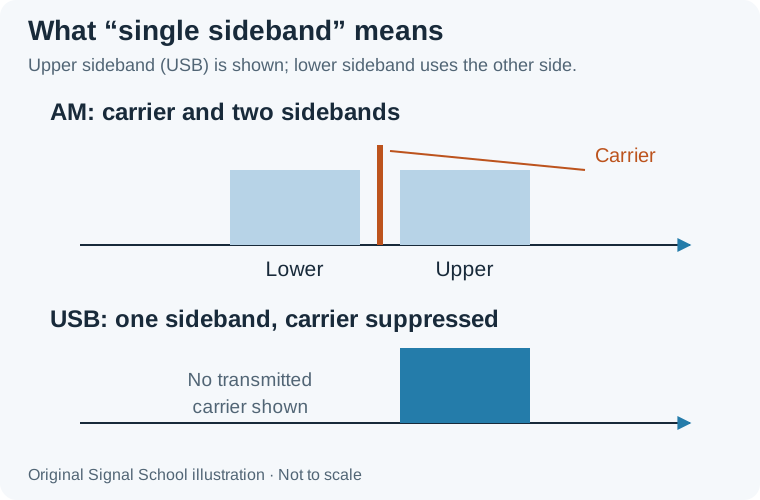
An SSB transmitter sends one sideband and suppresses the carrier. USB keeps the upper sideband; LSB keeps the lower one. The drawing illustrates the idea, not exact occupied bandwidth.
Open larger image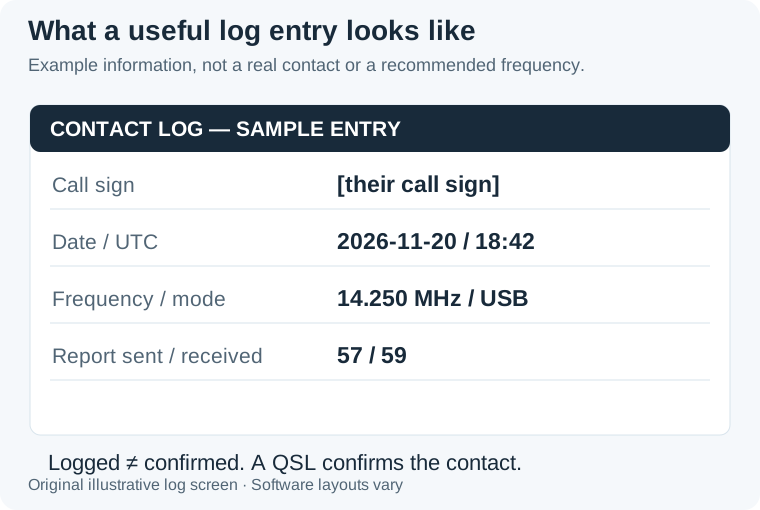
A saved log records your side of the contact. A QSL is a separate confirmation. The call sign placeholder and sample details here are fictional; use the actual details of your contact.
Open larger imageCheck privileges and equipment
Confirm that your license permits voice on the exact frequency you plan to use. US Technician HF privileges are limited; they do not cover voice throughout the HF bands. Use the current band chart, the appropriate sideband or mode, and an antenna suitable for the band.
Look for activity, not just noise
Listen for understandable stations. More hiss does not by itself mean a band is open; it can also be interference. Activity changes with time and propagation. If you hear nothing, check the receiver controls, antenna connection, and another band or time with an experienced operator.
Choose a clear invitation
For a first try, answer a station calling CQ that you can hear clearly. CQ invites a contact. Listen long enough to understand whether the operator wants a brief exchange, is running a contest, or is calling a particular region. Wait until their transmission ends.
Make a short reply
Say the calling station’s call sign followed by your own, using standard phonetics when helpful. If acknowledged, exchange call signs, a truthful signal report, your first name, and a general location. You can say that this is your first HF contact. Let the other operator’s pace guide the conversation.
Record it and try again
Note the other call sign, UTC date and time, frequency or band, mode, and signal report. If you receive no reply, wait and try another suitable station later. A missed reply is not a verdict on your skills; radio paths and local noise can differ at each end.
Try it together
Listen together and write down a call sign you can hear. Practice reading it back with phonetics before any on-air attempt.
Inspired by beginner learning material shared by Patrick Brown, N7FHB. Written and updated for Signal School.
Keep learning
Reviewed November 20, 2026.