What is on the Technician ham radio exam?
Learn what to study for the first US ham radio license, one topic at a time.
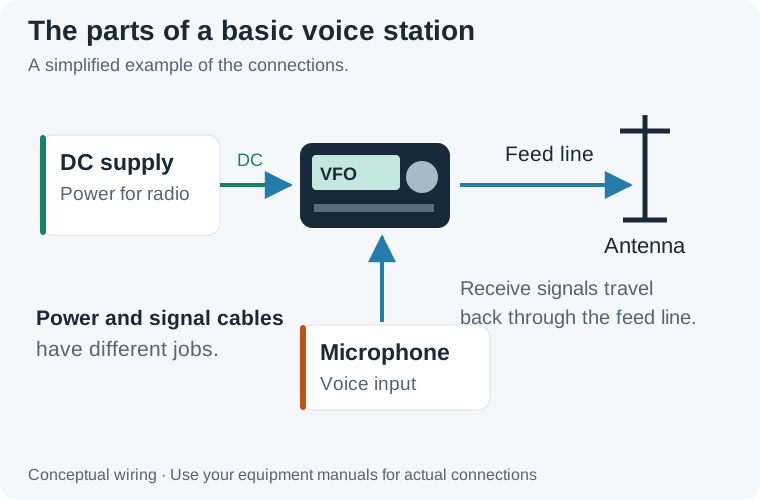
Power, microphone audio, and radio frequency signals have different paths. Received signals travel from the antenna back through the feed line to the radio. This is a concept diagram, not installation wiring.
Open larger imageRules and operating
Learn station identification, who can operate, and how to share frequencies. Imagine an actual conversation on the radio: listen first, identify your station, and communicate clearly. Understanding the reason behind a rule makes it easier to remember.
Signals, stations, and antennas
Explore how radio waves travel, how repeaters extend local coverage, and what the parts of a station do. A transmitter creates a radio signal, an antenna sends it into the air, and a receiver turns incoming signals back into useful information.
Electricity and safety
Get comfortable with voltage, current, resistance, and power. Learn safe antenna installation, battery handling, and radio frequency exposure practices. Treat a missed safety question as a chance to learn something that matters outside the exam too.
Use the right question pool
Signal School uses the Technician pool for July 1, 2026 through June 30, 2030. The exam has 35 multiple choice questions. Start with a short practice round, then study by section and use full exams to check your progress. Morse code is not required for this license.
Keep learning
Reviewed November 20, 2026.